



Evolve Your API Governance Process in the Age of AI

Key Takeaways:
To stay competitive in the AI era, enterprises must evolve their API governance process beyond security and compliance. Governance in the AI age means ensuring APIs are documented, discoverable, and AI-ready for both human and machine consumption.
Artificial intelligence (AI) has transformed how we design, manage, and consume APIs. In an age of uncertainty and rapid change, one thing is clear: there is no AI without APIs. APIs are the lifeblood of modern enterprises, connecting data, systems, and services. It’s this that enables AI systems to learn, reason, and deliver value.
However, most APIs are not AI-friendly, and many barriers to AI discovery and consumption are the same as those we’ve seen blocking developer reuse in the past; especially poor documentation. API governance is a critical capability to overcome these barriers, but most enterprise governance processes were established long before AI entered the scene. Traditional models focused on security, versioning, and access control.
In the AI era, governance must evolve to ensure APIs are not only secure and compliant but also discoverable, machine-readable, and ready for AI consumption.
From Bottleneck to Innovation Enabler: The New Role of API Governance
API governance has traditionally had a bad reputation for slowing down innovation and generating additional overhead for already overburdened developers. The implementation of governance process and frameworks has also not been standardized across enterprises and tooling. Many focused on governance as a runtime security enforcer, while others focused on coding standards and linting rules.
But as AI becomes an enterprise-priority, governance must shift from excessive control to enablement.
Modern API governance empowers both developers and AI agents to find, trust, and use existing APIs safely. It’s about updating existing APIs so that can be consumed by humans AND intelligent systems, without sacrificing security or compliance.
In this new landscape, governance is not an obstacle but the foundation of responsible AI adoption.
What’s Driving the Evolution of API Governance?
1. Requirements for AI API Discovery and Consumption
Whether developers are manually building out agentic AI workflows, or you’re setting the foundations for autonomous API discovery by Large Language Models (LLMs) and/or AI agents, your APIs need more than just endpoints. API documentation and metadata is now a first-class citizen.
For AI tools to interpret what your API does and how to use it safely, your API documentation must include:
- Semantically Rich descriptions at both the API level and method level.
- Well documented Error codes
- Good Examples
- X extensions for AI discovery and consumption
2. Expanding Compliance and Regulation
Regulations such as the EU AI Act, GDPR, and NIST AI Risk Management Framework have extended compliance expectations.
Governance must now address questions like:
- Which APIs feed data into AI models?
- Who has access to sensitive inputs or outputs?
- How are AI-related API calls logged and audited?
3. Data Sensitivity and AI Integration Risks
AI systems often ingest vast amounts of data, sometimes through APIs that were never designed for this purpose.
Without strict governance, sensitive data may be exposed to public LLMs or inadvertently used in model training.
The Key Pillars of AI-era API Governance
Your modern governance process should focus on these interconnected pillars:
| Pillar | What it means | Example |
| Compliance and Security | Protect APIs as data gateways; enforce authentication, encryption, and auditability. | OAuth2, PII masking, audit logs. |
| Documentation and Metadata | Make APIs machine-readable for AI discovery and reuse. | Semantic tags, OpenAPI extensions. |
| Automation & Continuous Governance | Embed API governance rules across API lifecycle and automate where possible. | Policy-as-code, automated linting. |
| Discoverability & Catalogs | Centralize APIs to reduce sprawl and support AI-based search. | Catalog platforms like ignite from digitalML. |
| Cross-Functional Oversight | Unite API, data, and compliance teams under shared governance. | Governance councils, shared metrics. |
Using AI to Improve Governance
Not only is AI driving change, it’s also useful for solving challenges in the governance framework.
LLMs and generative AI tools can:
- Enrich API documentation based on specifications or code
- Flag incomplete or inconsistent metadata
- Aid API discovery by providing a natural language query interface into large API inventories
But this must be done responsibly, and in a way that does not compound API sprawl and operational chaos.
For example:
- When using GenAI to augment documentation, standardized prompts and sensitive field masking/redaction ensures security – especially when working with public LLMs.
- Enhancing existing APIs rather than building new AI-ready versions to minimize sprawl, cost, and operational overhead.
A Framework to Evolve Your API Governance Process
If you’re looking to evolve your governance approach, here’s a suggested step-by-step roadmap for enterprises:
- Assess your current governance maturity. Identify documentation gaps, inconsistent standards, and compliance blind spots.
- Define AI-era policies covering metadata, access, and AI-specific risks.
- Centralize APIs in a unified catalog to bring visibility across teams and runtimes.
- Automate with tools that help make your APIs AI-ready and gold standard quickly without compounding API chaos.
- Look for opportunities to leverage generative AI and LLMs within the governance process itself.
- Review continuously. Governance must evolve alongside new AI regulations and model capabilities.
This approach turns governance from a static checklist and reactionary tasks into a living, responsive, and proactive process.
How the ignite Platform is helping enterprise modernize API governance
digitalML’s ignite Platform is one of the top API catalog and governance tools for large enterprises. ignite supports the rapid upgrade of your key existing APIs whilst actually bringing your API chaos under control at the same time.
ignite separates API governance into two core concepts so you can easily evolve your process. The first is compliance which ensures APIs are secure and deployment ready. The second is reuse which ensures API documentation and metadata are treated as first-class citizens to ensure your APIs are usable by both human and machines.
Using centrally administered guide rails for AI Prompts and LLM Masking (Redaction) users can use generative AI to rapidly bring the APIs up to gold standard for reuse by both AI consumer and Developer consumer.
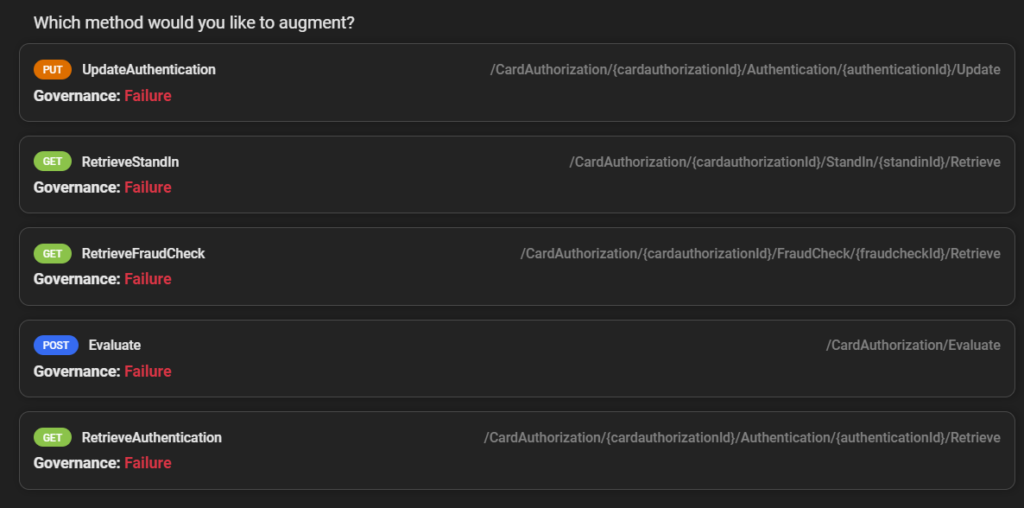
With ignite’s vendor-agnostic catalog full of Gold Standard APIs, AI can also be used to easily navigate through the huge numbers of APIs you have to find the exact one to reuse.

In addition, as you build MCP servers to support agentic AI implementation, ignite can catalog them and record which APIs they group together.
Conclusion: Governance as the Backbone of AI Adoption
As enterprises race to adopt AI, the stability and success of those systems depend on well-governed APIs.
Evolving your API governance process isn’t just a nice-to-have – it’s key to maintaining competitive advantage.
By aligning compliance, documentation, and automation, organizations can build trustworthy, AI-friendly APIs that fuel innovation.
In the AI era, good governance isn’t about slowing progress. It’s how progress scales safely.
About the Author
Differentiate Your Digital Enterprise Now
Learn how it can help your enterprise accelerate digital transformation